
Fences
Boundaries, Edges, and Corner Cases

Systems engineering is a robust field that has a rich history dating back to just before World War II. As weapons advanced they started specifying operational requirements to the military industrial complex to deliver against. Concurrently, scientific innovations were independently pursued by researchers in physics, chemistry, mathematics, biology, and the social sciences.1 As with much of the hard systems disciplines, the origins tie to the aerospace industry. Various types of flight performance charts ( examples ) connoted the use of the terms edge, corner, and boundary cases. Corner and edge cases refer to the boundaries around system design parameters for flight envelope testing of the where unknowns proliferate ( greater than 3 Sigma deviations or 99.865%).
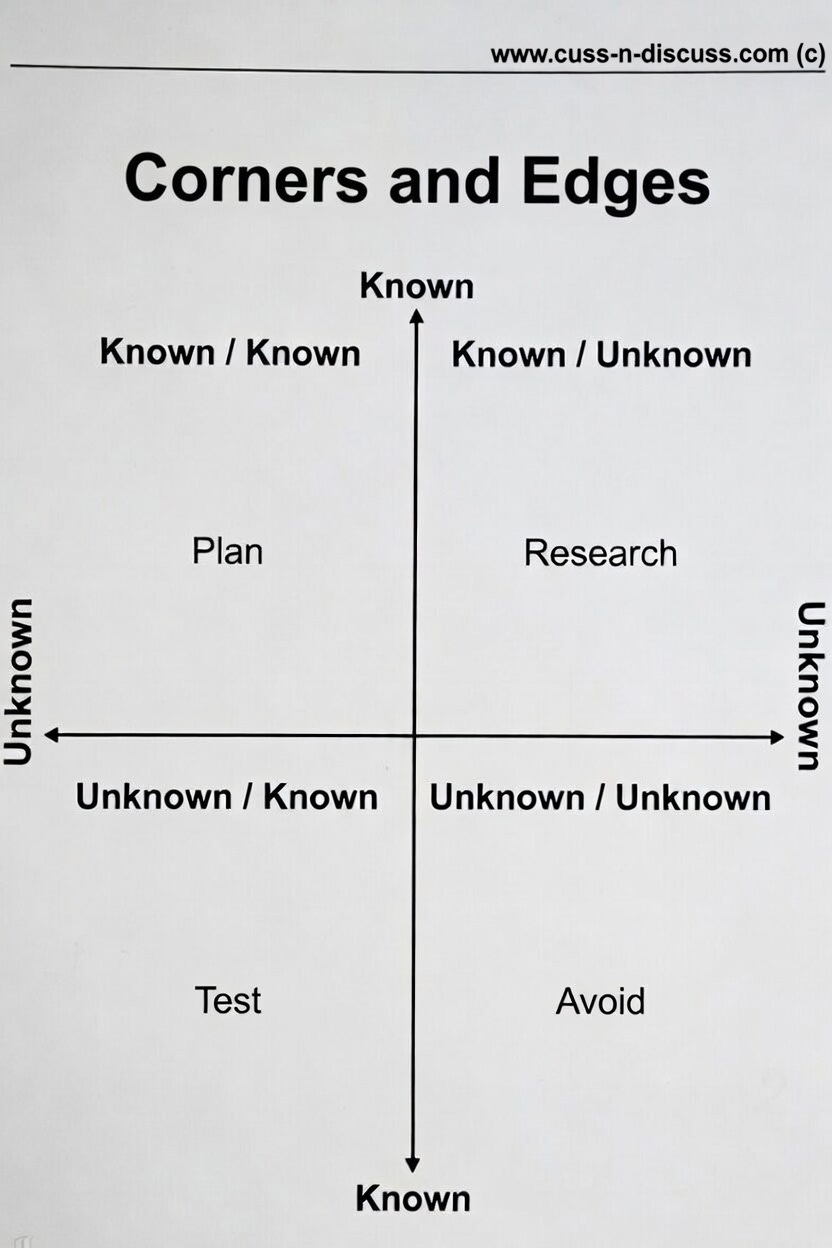
The charts lent themselves nicely to the use of ‘corner’ - where the chart does not exist (off-chart) while the edges help capture the curves of categorized performance boundaries (on-chart). Establishing these parameterized conditions was done through calculation ( Planning ), extended with ( Research ), and validated with ( Testing ) by pilots. Thus, test pilots. Confidence intervals were based upon statistical parameters calculated by hand and later with mechanical computers, and eventually the first electronic machines. Ironically, those machines were first used for the calculation of artillery charts. Trajectories factoring heavily into both literally and metaphorically sometimes with tragic results aka when someone or thing became a lawn dart and burned in. Recently, a blockbuster pop-cultural reference, about moving from Test into Unknown/Unknown ( Avoid ) was presented in Top Gun: Maverick when Tom Cruise’s movie character Maverick takes the Top Secret Hypersonic Darkstar beyond Mach 10.
Test pilots pushed the known boundaries with knowledge, experience, determination, and courage. In doing so they helped redefine the engineering, methods, and parameters for military and civil aviation to follow. This complex stew, sans perhaps courage, tested the advanced systems of the day - often times resulting in failure. Here, at FAIL is where I’ve ‘earned’ this moniker. For I seem to have an uncanny ability to push systems into areas their builders and designers did not consider. Following a unique trajectory through complex systems like modern technology.
If you’re not already a subscriber please:
This research was not always completely independent. In fact, subsequent to WWII world governments increasingly began contributing to academic research and development. https://nsf-gov-resources.nsf.gov/2023-04/EndlessFrontier75th_w.pdf